- Category
- Inversions
- Level
- advanced
- Hold
- 30 seconds building to 3 minutes with consistent practice
- Type
- Asana
- Breath
- Smooth, quiet breathing through the nose; if the breath turns ragged, come down.
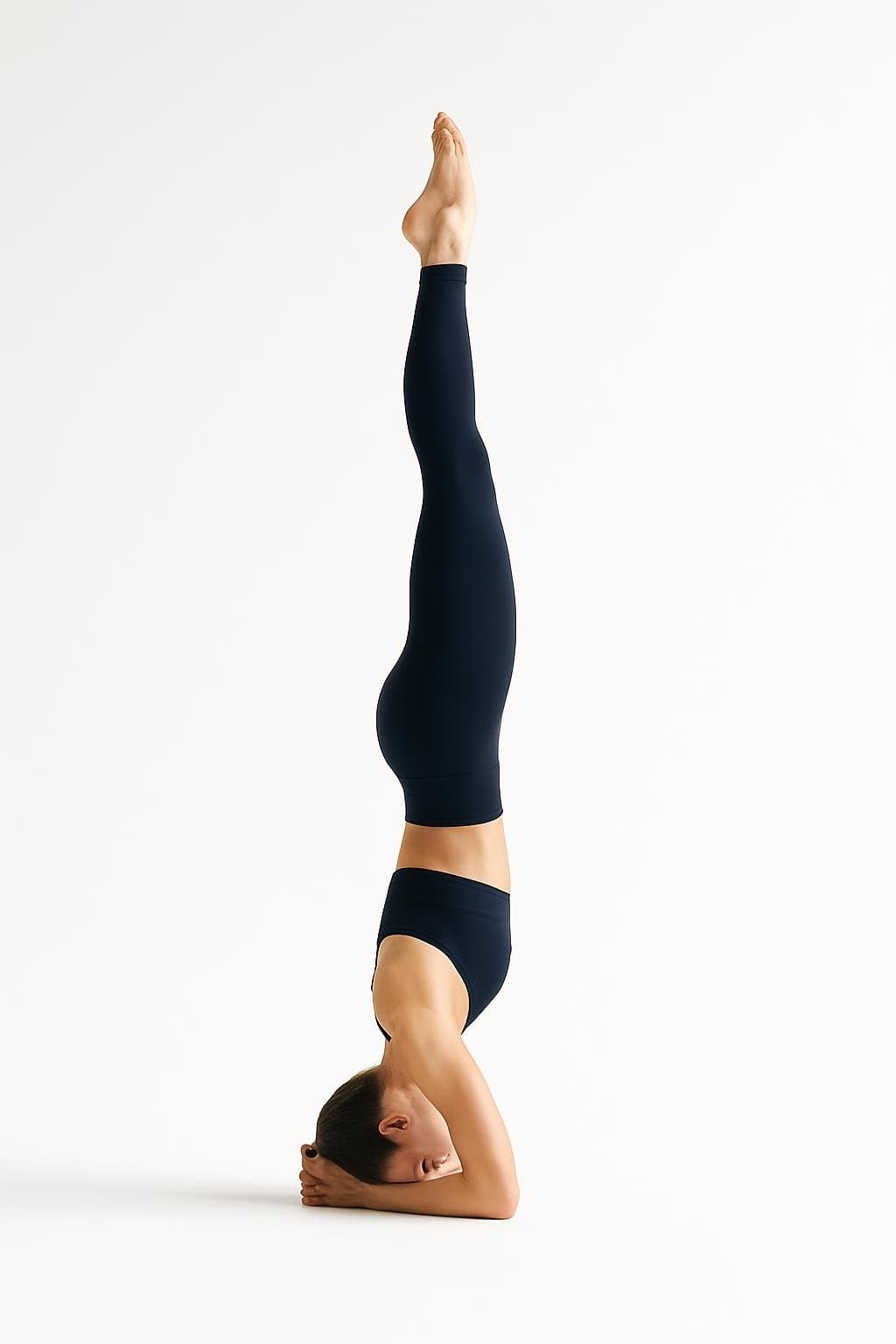
Supported Headstand
Salamba Sirsasana — "supported head-standing posture"
A full inversion balanced on the forearms and crown of the head. Rewarding, but genuinely advanced: it loads the neck, and it deserves months of patient preparation at a wall, ideally with a teacher.
Step by step
- 1Learn this pose at a wall first — set up with your knuckles about a palm's distance from the wall so it can catch you without letting you bank into it.
- 2Kneel down, interlace your fingers, and place your forearms on the mat with elbows shoulder-width apart.
- 3Place the crown of your head lightly on the floor, the back of your head cradled by your hands.
- 4Press your forearms down strongly so most of your weight stays in your arms, not your neck.
- 5Tuck your toes, lift your hips, and walk your feet in until your hips stack over your shoulders.
- 6Draw one knee toward your chest, then the other — do not kick or jump up.
- 7Slowly extend both legs toward the ceiling, keeping your ribs in and legs together.
- 8To come down, bend your knees toward your chest and lower one foot at a time with control, then rest in child's pose.
Benefits
- ✓ Builds strong shoulders, arms, and core through the sustained press of the forearms
- ✓ Trains balance, focus, and calm in a completely inverted position
- ✓ Reverses the usual pull of gravity on the legs and torso
- ✓ Develops body awareness that carries into every other inversion
Make it yours
- · Practice at a wall for as long as it takes — months is normal — before trying the middle of the room.
- · Build strength in dolphin pose and practice walking the feet in without lifting them at all.
- · Work with headstand prep: hips stacked, one knee tucked to the chest, feet returning lightly to the floor.
- · A folded blanket under the head and forearms can ease pressure, kept thin so stability isn't lost.
Take care
- Avoid this pose if you have a neck injury or ongoing neck pain — the setup depends on a healthy cervical spine.
- Full inversions are generally not advised with high blood pressure, glaucoma or other eye conditions, or during pregnancy; if any of these apply to you, choose legs up the wall instead.
- Skip it when you feel dizzy, congested, or fatigued, and come down at the first sign of neck strain.
This is general practice guidance, not medical advice. If something hurts, ease out of it.
Practiced in
Props that help here
- Yoga blanket — Folded under the hips in seated poses, under the knees in kneeling ones, under the shoulders for shoulderstand. A firm household blanket works too. find one
- Wrist wedge — Reduces the wrist angle in plank, chaturanga, and arm balances. Worth trying before concluding your wrists can't do this. find one
Affiliate links — we may earn a commission at no cost to you. All gear recommendations